
GOYOJO GRL335 Review: Real-World Range, Image Quality & Hunting Performance
Introduction
If you are researching a GOYOJO GRL335 thermal scope, the most useful information is not simply a list of specifications or a maximum detection number. The more important questions are practical: How does the image perform on moving animals? At what distance can a hunter identify a target rather than simply detect heat? How well does the optic hold zero after recoil and remounting? And how practical is it during a long night in the field?
This article examines the independent field review of the GOYOJO GRL335 published by AJ Deysel on LoadDevelopment.com, focusing on observations reported during predator and wild boar hunting, range training, and general field use.
The field observations discussed below come from that third-party review. Current product specifications are identified separately as GOYOJO specifications. GOYOJO did not conduct the third-party field testing.

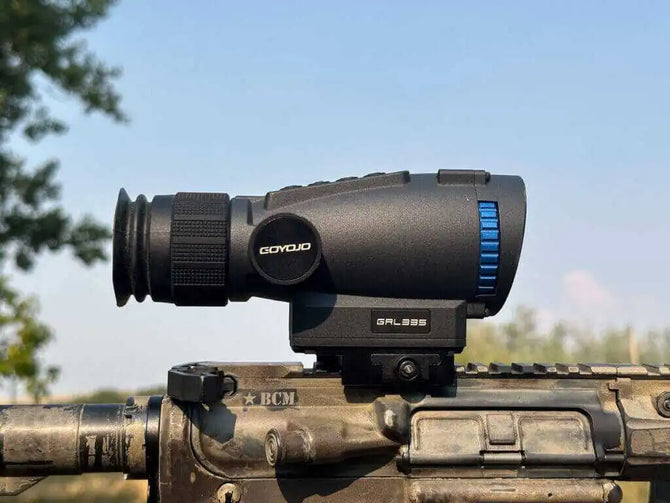
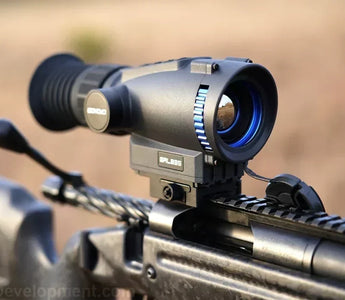
The GRL335 mounted on a varmint rifle in LoadDevelopment.com’s field review.
GOYOJO GRL335 at a Glance
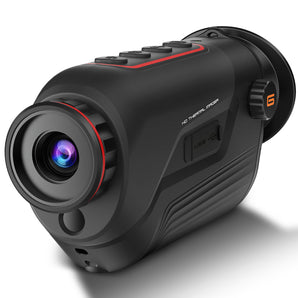
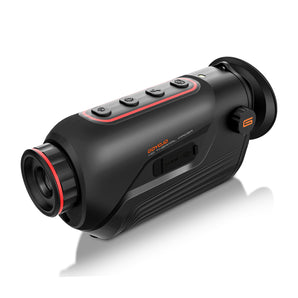
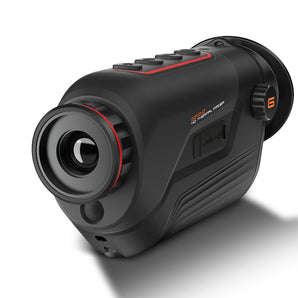
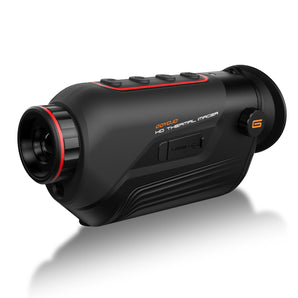
The GRL335 is a rifle-mounted thermal optic built around a 384×288 thermal sensor, 12μm pixel pitch, 35mm objective lens, and 4× base magnification. The current product configuration also lists a 1024×768 OLED display, 55Hz refresh rate, and a 6.5° × 4.5° field of view.
The combination tells you a lot about how this optic is intended to be used.

The GRL335 mounted on a rifle during AJ Deysel’s field review for LoadDevelopment.com.
What Was Tested?
The GRL335 was evaluated in real outdoor conditions, including extended nighttime use, target observation, mounting and handling, and repeated use in changing weather conditions.
Rather than focusing only on manufacturer specifications, the field test looked at practical questions:
-
How clearly can heat signatures be tracked?
-
At what distance can a target be positively identified?
-
How useful is the 35 mm objective lens in the field?
-
How does digital zoom affect image detail?
-
Does the optic maintain zero after repeated use?
-
How practical is the battery system for a long night outdoors?
-
How does the optic handle rain, moisture, recoil, and transportation?
These observations are particularly useful because thermal performance can vary considerably between laboratory specifications and real-world use.
What Does the GRL335 Actually See at Distance?
One of the most important parts of the third-party review was the distinction between detection and identification.
These terms are often treated as if they mean the same thing, but they do not.
Detection means noticing that a heat source or animal is present.
Recognition means determining what type of object or animal you are looking at.
Identification requires enough information to confirm the animal and understand its orientation and relevant aiming area.
According to the reported field observations, deer-sized animals could be detected at approximately 500 to 600 yards under the tested conditions. However, positive identification occurred much closer, at approximately 150 to 200 yards, depending on conditions and target presentation.
That difference is important when evaluating any thermal scope.
A long detection distance does not mean that an animal can be positively identified at the same distance.
GRL335 Reported Range in the Field
| Distance | Reported observation | Practical meaning |
|---|---|---|
| 50 yards | Moving coyote tracked | Close-range movement tracking |
| 100 yards | Hog shoulder detail visible | Useful aiming reference |
| 150–200 yards | Positive identification reported | Practical identification range under reported conditions |
| Around 400 yards | Heat source visible, detail reduced | Detection without dependable identification |
| 500–600 yards | Deer-sized animals detected | Detection range, not identification range |
These observations come from the specific third-party test and should not be interpreted as universal performance guarantees. Weather, humidity, target size, vegetation, background temperature, and target presentation can all affect thermal image performance.

A tripod-supported thermal hunting setup shown in LoadDevelopment.com’s GRL335 field review.
384×288 Resolution and 35mm Objective: What Do They Mean in Practice?
The GRL335 uses a 384×288 thermal detector with 12μm pixel pitch and a 35mm objective lens.
For hunters comparing thermal scopes, these numbers should be considered together rather than separately.
The 384×288 detector provides the native thermal image information, while the 35mm objective and 4× base magnification influence how that information is presented through the optic.
The current configuration also includes a 1024×768 OLED display and 55Hz refresh rate.
The result is a rifle-mounted thermal optic with a relatively tight native view.
That can be useful after an animal has already been located. The hunter does not need to rely entirely on digital magnification to create a tighter viewing window.
Is 4× Magnification Good for Thermal Hunting?
The GRL335 provides digital magnification for situations where additional enlargement is needed.
As with digital zoom on thermal optics generally, increasing magnification does not create additional sensor information. The image can become softer as digital magnification increases.
The field test reflected this trade-off: the native 4× view generally provided the most useful combination of image detail and clarity, while higher digital magnification was more appropriate when additional visual enlargement was needed.
For critical identification, using the native image whenever possible is therefore preferable to relying heavily on digital zoom.
What About Digital Zoom?
The review also noted that heavy digital zoom softened image clarity.
That is a useful observation because digital magnification and native optical magnification are not equivalent.
If an optic already provides 4× base magnification, much of the practical viewing work can be done using its native image. Digital zoom can still be useful when appropriate, but increasing magnification digitally does not create additional native thermal detail.
For important identification decisions, the native image should remain the primary reference.
Does the GRL335 Hold Zero?
Zero retention was another significant part of the third-party evaluation.
The reviewer reported that the integrated Picatinny mounting system maintained point of impact through multiple range sessions and hunting use. The optic was also removed and returned to the same rail position, where it continued to hold zero during the reported testing.
For a rifle-mounted thermal optic, this is an important practical consideration.
An optic can have good image quality but still create frustration if the mounting system requires frequent re-zeroing.
The GRL335 uses a tool-free, finger-adjustable mounting tension system, which is particularly relevant for hunters who remove an optic during transport or use the same prepared setup repeatedly.
At the same time, remounting an optic should not eliminate the normal practice of confirming zero before a hunt.

A thermal target view from the zeroing context in LoadDevelopment.com’s GRL335 review.
Battery Life: What Happens During a Long Night?
Battery management is one of the practical considerations that can easily be overlooked when comparing thermal optics.
The GRL335 uses a replaceable 18650 battery, allowing users to carry spare cells rather than relying entirely on a built-in battery.
During field use, the reviewer reported approximately 5–7 hours of practical runtime, depending on usage.
GOYOJO's current specification lists runtime of up to 6–8 hours.
The difference between these figures is not necessarily contradictory. Actual runtime can change according to:
-
display brightness
-
digital zoom
-
recording functions
-
ambient temperature
-
standby time
-
battery condition
-
operating mode
For extended nighttime use, the replaceable battery design also provides a practical advantage: carrying additional charged batteries can extend an outing without requiring access to a power outlet.
How Does the GRL335 Handle Rain and Field Use?
The third-party review included humid and drizzly conditions, rifle transport, repeated handling, and recoil.
The reviewer reported no rattling internals, loosened components, or visible structural problems during the described use.
GOYOJO's current product information lists the GRL335 as IP65.
Who Is the GOYOJO GRL335 Best Suited For?
The GRL335 is particularly relevant to users looking for:
-
A 35 mm thermal optic with higher native magnification
-
384 × 288 thermal resolution
-
Practical nighttime observation
-
Longer-distance target identification
-
Replaceable batteries for extended sessions
-
A compact optic designed for outdoor conditions
-
A balance between thermal performance and overall cost
For users who primarily need a wide scanning view at close distances, a lower-magnification thermal optic may be more appropriate.
For users who prioritize additional native magnification and detail at moderate-to-longer distances, the GRL335's configuration is worth considering.
What Stands Out About the GRL335?
Based on the third-party field observations and current product specifications, several characteristics define the GRL335.
384 × 288 Thermal Resolution
The 384 × 288 sensor provides a substantial amount of thermal information for a compact optic and supports practical target observation and identification.
35 mm Objective Lens
The 35 mm lens works with the 4× native magnification to emphasize detail at moderate and longer distances.
Replaceable Battery System
The use of 18650 batteries makes it possible to carry spare cells for longer sessions.
Practical Field Performance
The third-party evaluation provides real-world observations that specifications alone cannot show, including image usability, zero retention, battery performance, and handling.
5-Year Warranty
The GRL335 is backed by a 5-year warranty from GOYOJO, providing additional coverage for long-term ownership.
GRL335 vs. a Higher-Resolution Thermal Scope
Not every thermal hunter has the same priorities.
The GRL335 uses a 384×288 thermal detector. GOYOJO's GRL635 configuration uses a 640×512 detector.
The difference is primarily relevant to buyers who place a higher priority on native image detail and longer-distance observation.
| GRL335 | GRL635 | |
|---|---|---|
| Thermal Resolution | 384×288 | 640×512 |
| Objective | 35mm | 35mm |
| Base Magnification | 4× | 4× |
| Primary consideration | Practical close-to-moderate-range use | Higher native image detail |
| Key difference | Lower-resolution sensor | Higher-resolution sensor |
The choice is therefore less about which specification is universally preferable and more about how much native thermal detail your typical hunting situation requires.
If your main use involves close-to-moderate distances, the GRL335's 384×288 configuration may provide the level of image information you need.
If finer native detail at longer distances is a higher priority, the 640×512 GRL635 is the configuration worth comparing.

Image showing the GRL335 packing list details, provided by a review from AJ Deysel at loaddevelopment.com.
What the Independent Review Actually Tells Us
The most useful takeaway from the LoadDevelopment field review is not one single maximum-range number.
It is the relationship between distance and usable information.
The reviewer reported:
-
Smooth tracking of a moving coyote at approximately 50 yards
-
Useful aiming detail on a hog at approximately 100 yards
-
Positive identification at approximately 150–200 yards under the reported conditions
-
Detection of deer-sized animals at approximately 500–600 yards
-
Zero retention through the reported range and field sessions
-
Successful same-position remounting during the described use
-
Five-to-seven-hour field battery estimates depending on conditions
-
Rapid 18650 battery replacement
Together, these observations provide a more useful picture of the GRL335 than a single detection-distance specification.
The optic's 4× native magnification, 35mm objective, 384×288 sensor, replaceable 18650 battery, and integrated mounting system also help define where it fits within a thermal-optic setup.
The important limitation is equally clear: detection at a long distance should not be confused with positive identification at that distance.
Frequently Asked Questions
How far can the GOYOJO GRL335 detect an animal?
The independent field review reported detection of deer-sized animals at approximately 500–600 yards under the tested conditions. This refers to detection of a heat source, not reliable identification.
How far can the GRL335 identify an animal?
The third-party review reported positive identification at approximately 150–200 yards, depending on conditions and target presentation.
What resolution does the GRL335 use?
The GRL335 uses a 384×288 thermal detector with 12μm pixel pitch.
What magnification does the GRL335 have?
The current configuration uses 4× base magnification. Digital magnification is also available, but heavy digital zoom can reduce perceived image clarity.
How long does the GRL335 battery last?
GOYOJO's current product information lists approximately 6–8 hours of operation. The independent reviewer estimated approximately 5–7 hours under field conditions depending on temperature and display brightness.
What battery does the GRL335 use?
The GRL335 uses a replaceable 18650 battery.
Final Takeaway
The most useful part of the GRL335 evaluation is not a single specification or maximum range number.
It is the combination of 384 × 288 thermal resolution, a 35 mm objective lens, 4× native magnification, replaceable batteries, and real-world field testing.
The LoadDevelopment evaluation provides practical context for how those specifications translate into actual outdoor use. The reported observations showed usable thermal detail, practical target identification at moderate distances, consistent zero during testing, and several hours of battery operation.
At the same time, the evaluation highlights the trade-offs that come with the configuration: the 4× native magnification provides additional detail but reduces the native field of view, while digital zoom should be used selectively when image detail is important.
For buyers comparing thermal optics, these practical trade-offs are often more useful than a specification sheet alone.
Explore the current GOYOJO GRL335 Thermal Scope configuration and specifications on GOYOJO Optics.
Source & Editorial Disclosure
This article is an original GOYOJO Optics analysis based on the independent GRL335 field review published by LoadDevelopment.com. The field observations are attributed to the third-party reviewer and are not presented as GOYOJO's own testing results.
Current product specifications are provided exclusively by GOYOJO; please refer to the current product page.
GOYOJO did not conduct the third-party field testing described in this article.