
A First-Time-Friendly Thermal Scope in the Mountains
Coldboremiracle’s third-party GRL335 review answers practical buyer questions: how quickly the scope mounts and zeros, whether its controls work naturally in the dark, and how focus and color settings help interpret a thermal scene.
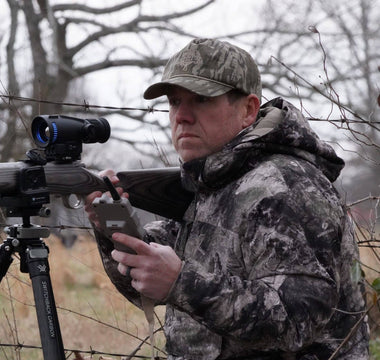
The reviewer mounted the compact GRL335 on an AR-15-pattern Quattro 15 and carried it during several mountain trips. He looked for squirrels, marmots, and possibly a coyote while also observing animals that were not targets. This repeated outdoor use gives prospective buyers a useful view of how the scope fits a real hunting routine.

His strongest theme was simplicity: a compact, feature-rich optic whose mounting, zeroing, focusing, recording, and field adjustments were easy to understand.
Quick-Detach Mounting and a Zero Learned in Minutes
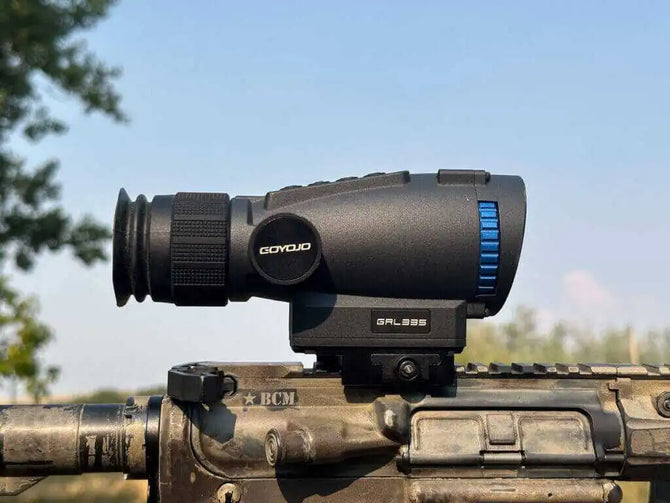
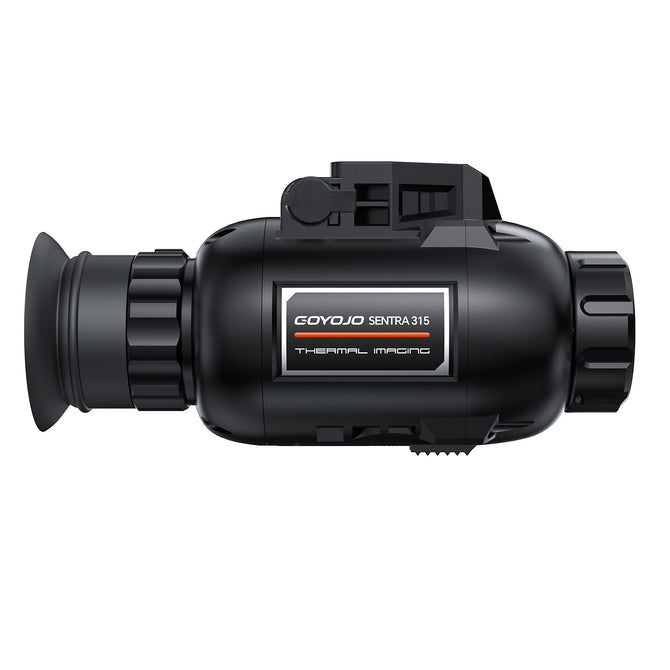
The GRL335 attached to the rifle through its quick-detach clamp. Coldboremiracle found installation easy and noted that the clamp included a security lock designed to help prevent unintended opening. The supplied mounting brackets also allowed the position of the mounting foot to be changed, giving the user some flexibility when arranging the optic on a rail.

For zeroing, the reviewer fired a shot, opened the zeroing menu, froze the displayed frame, and moved the reticle from its starting position to the observed point of impact. It took a couple of attempts while he learned the system, but he reported reaching a useful zero for his field evaluation within a few minutes. He then explored the available reticles and zoom settings before heading into the mountains. In his own pros list, he summarized the experience as quick to zero, easy to understand, and easy to adjust.
On this rifle, the digital mounting and zeroing workflow became familiar quickly.
Simple Controls That Work by Touch
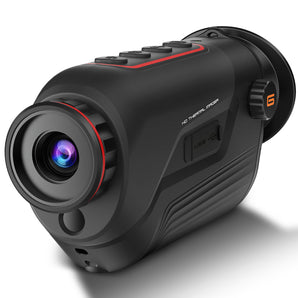
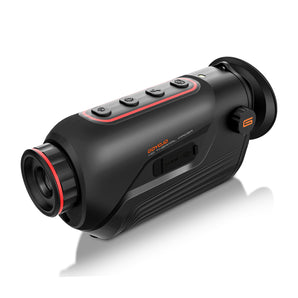
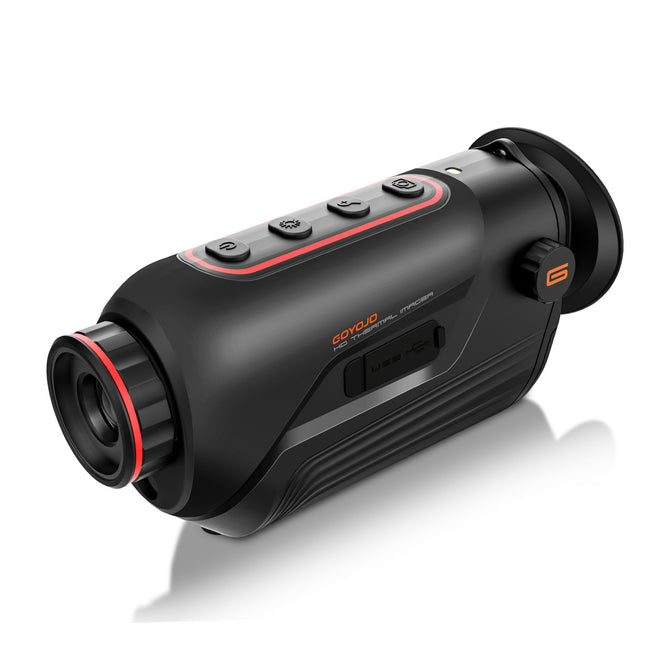
Controls were one of the clearest strengths in the source. The four-button panel placed frequent actions within immediate reach, allowing the reviewer to change zoom, move between color palettes, take a photograph, or begin recording without lifting his eye from the display. More detailed settings—including reticle type, reticle color, and zeroing—remained available through the menus.

The physical placement mattered as much as the menu design. Coldboremiracle liked that the pad sat centrally on top of the optic, where either hand could reach it. Its textured surface also provided tactile orientation in darkness. For a hunter following movement through the display, that means common changes can remain part of the viewing process instead of becoming a separate stop-and-search task.
For a first-time thermal user, that direct control scheme leaves more attention available for the scene.
Clear Focus and Target Recognition in Real Terrain
Thermal identification depends on more than finding a bright shape. The reviewer observed that rocks, trees, and other objects can hold different temperatures, with daytime conditions sometimes making a scene harder to interpret until an animal’s form or movement becomes recognizable. He found the GRL335’s color palettes useful for separating targets from their surroundings, while zoom helped him judge scale and view more detail.
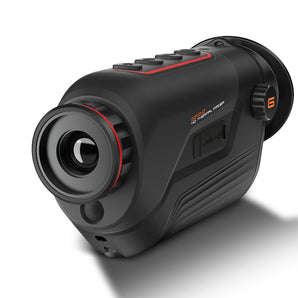
Accurate focus was another important part of that process. The front objective-focus control was easy to grasp, and its recessed position helped protect it from being moved unintentionally. Coldboremiracle reported that the sensor could be focused sharply on subjects as close as a few feet and said he was impressed by how clean the image could look. A separate rear adjustment focused the display for the user’s eyesight, and two rubber eyecups were included.
In terrain with several warm surfaces, focus, palette, and magnification helped the reviewer move from seeing heat to interpreting an animal and its surroundings.
What the Reviewer Saw at About 120 Yards
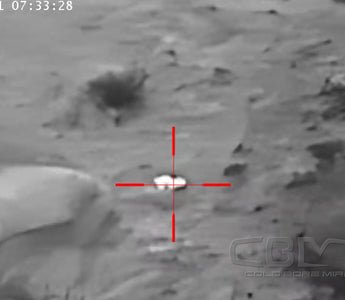
The review’s most concrete distance example is an image of the reviewer’s dog at approximately 120 yards. Coldboremiracle described the dog as showing up very well in the scope. Because it was a familiar animal, the frame also illustrates how recognizable body shape, scene knowledge, focus, and thermal contrast work together during real observation.

Detection means noticing heat, recognition means classifying the general subject, and identification means deciding what it is with confidence. At about 120 yards, this reviewer saw enough form to recognize his familiar dog clearly—a useful field observation rather than a number alone.
Capturing Photos and Video in the Field
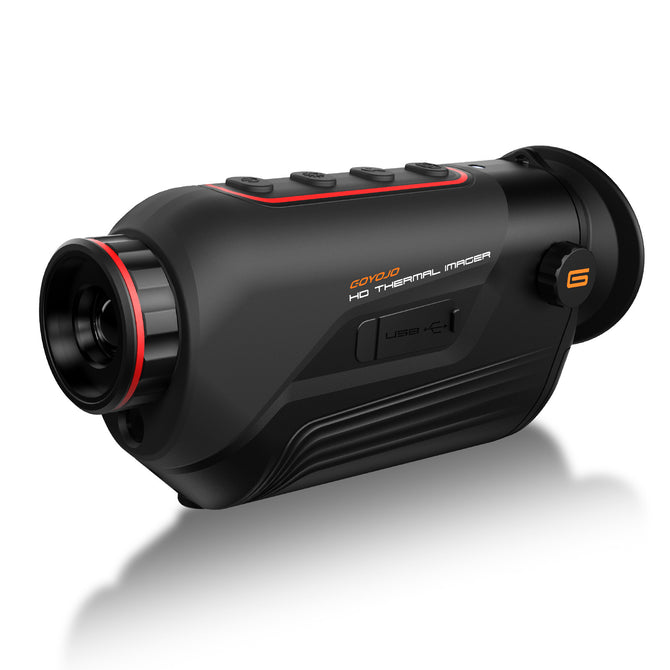
Onboard capture was more than an unused menu item in this review. Coldboremiracle recorded stills and clips during shooting and outdoor use. Pressing and holding the X button switched between photo and video modes, and the same control then captured an image or started recording. Files were stored on the microSD card in the optic’s base near the USB-C port, making it possible to move MP4 files to another device.
The reviewer did encounter a few problems editing or manipulating some MP4 files. He could not determine whether the files themselves or his software choice caused the issue, and he ultimately found a way to use both the pictures and video. That makes software compatibility a sensible workflow check for users who expect to edit every hunt, while the successful captures still support recording as a practical GRL335 feature.
One product-detail difference is worth keeping clear. The source review’s feature list says “Audio: No,” while current GOYOJO product information lists photo, video, and audio capture. Buyers who specifically need audio should check the current configuration and documentation for the unit they select.
Battery Backup, Included Gear, and First-Thermal Value
Power management also earned positive feedback. The removable battery can be charged outside the optic, and the reviewed package included an extra battery and charger. Coldboremiracle characterized battery life as great and liked being able to carry a charged backup in a pocket. For an evening hunt or a trip away from a convenient outlet, a swappable battery is easy to understand and easy to plan around.
The package arrived in a zippered soft case with additional eyecups, charging cables, mounting hardware, batteries, and a manual. Those items reinforced the reviewer’s sense that the GRL335 was ready for a new thermal owner. His pros list highlighted affordability, the compact footprint, quick zeroing, image capture, and the included accessories.
At the price discussed in the source, he called the feature-and-function package a great value and said it made sense as a first thermal. His reservations were the brand’s unfamiliarity to him, overseas manufacture, and the durability he intended to assess through continued use. Those points did not change his overall conclusion: he liked the optic, planned to keep using it during hunting adventures, and repeatedly praised how easy its functions were to adjust and understand.
Who This GRL335 Review Helps Most
This field experience is most relevant to hunters and landowners shopping for an approachable rifle-mounted thermal with direct controls, 4× base magnification, replaceable power, and onboard media capture. It also speaks to users who want to move between close observation and more distant scanning and are comfortable adjusting objective focus as the scene changes.
The review’s mountain and varmint context makes it especially useful for someone interested in nighttime property observation, small-game opportunities, or predator hunting at practical field distances. Buyers still comparing form factors can browse GOYOJO’s thermal scope collection, while keeping the GRL335’s combination of compact size and simple operation at the center of this particular review.
Current GRL335 Specifications
Current GOYOJO product information places the reviewer’s experience in a useful technical context. The GRL335 configuration combines a 384×288 sensor and 35mm objective with 4× optical magnification. Its current core specifications are summarized below.
| Specification | Current GRL335 value |
|---|---|
| Thermal sensor | 384×288 VOx, 12μm |
| Thermal sensitivity | NETD <25mK at 25°C, F/1.0 |
| Objective and optical magnification | 35mm and 4× |
| Digital zoom | 1×, 2×, 3×, 4× |
| Display and refresh rate | 1024×768 OLED and 55Hz |
| Field of view | 6.5° × 4.5° |
| Storage | 64GB |
| Battery and listed operating time | Rechargeable 18650; 6–8 hours |
| Weight without battery | 553g / 1.22 lb |
| Protection and warranty | IP65 and five years |
GOYOJO currently lists detection, recognition, and identification distances of 2,647 meters, 661 meters, and 329 meters using a 1.7 × 0.5-meter target under the stated conditions. Those figures provide product context; the Coldboremiracle review contributes the complementary field story of how focus, palettes, controls, and experience affected what the user could interpret.
Final Verdict
Coldboremiracle came away liking the GRL335 for the same reasons it may appeal to a first-time thermal buyer: the controls were simple, the zeroing workflow was quick to learn, focus was easy to adjust, and recording was available without complicating normal operation. Across several trips, he used the optic to find animals, explored the palettes and zoom settings, and captured a clearly recognizable view of his dog at about 120 yards.
The strongest value demonstrated by the review is accessibility. The GRL335 brought mounting, zeroing, viewing, recording, and battery management together in a compact package the reviewer felt comfortable taking back into the field. Hunters seeking that straightforward 384×288 setup can view the current GOYOJO GRL335 configuration and specifications.
Source and Editorial Disclosure
This article is an original GOYOJO Optics interpretation of Coldboremiracle’s third-party GRL335 review, using attributed reviewer observations and current GOYOJO specifications. GOYOJO did not perform the third-party testing. The source contains affiliate-tracking links and does not state whether the reviewed optic was supplied or whether the review was sponsored.